Remarkable creations are born at the intersection of art and engineering.
That connection was recently demonstrated through a collaborative effort between Applied Research Associates, Inc. (ARA), the U.S. Army Combat Capabilities Development Command (DEVCOM) Army Research Laboratory (ARL), and the Calder Foundation to restore “Mountains and Clouds”, an iconic steel sculpture in the atrium of the Hart Senate Office Building in Washington, D.C.
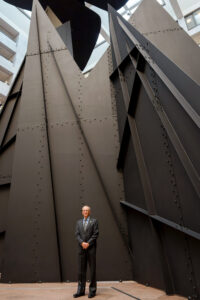
Installed in 1986 from a design selected by the Architect of the Capitol, “Mountains and Clouds” is the final work of renowned American sculptor Alexander Calder. The 51-foot-tall steel structure consists of five triangular mountains of varying heights, the largest of which pedestrians can walk through. According to the Architect of the Capitol, Calder had the entire sculpture painted flat black to contrast with the atrium’s shiny white marble.
In 2014, safety concerns were raised over the structural integrity of the work following a 2011 earthquake, and the “Clouds” portion of the installation was removed. Twelve years passed before the “Clouds” were reconstructed with carbon fiber composite as part of an extensive restoration effort made possible by private donors to reunite the “Clouds” to the mountain stabile. The signature “Calder Black” paint used for the sculpture is an ultra-low gloss that absorbs and diffuses light to create a unique contrast to its surroundings, creating sharp, distinct lines between the sculpture and the space around it, but the Calder Black paint needed is no longer commercially available.
To address this challenge, ARA Principal Scientist John Escarsega leveraged more than four decades of expertise in advanced coating technologies. After retiring from ARL, Escarsega joined ARA, bringing extensive experience in specialty coating formulations for defense applications.
“ARL’s mission is to execute fundamental research to accelerate the delivery of innovative science and technology to the warfighter,” Escarsega said. “That mission is closely aligned with ARA’s own work, and the effort to refurbish the art installation was a meaningful result of that fundamental research.”
The effort involved incorporating new resin materials, adjusting gloss levels, and creating a custom pigment blend to match the elusive black color specified by the Calder Foundation, resulting in a new paint coating specifically designed for this application and distinct from military-use formulations.
Protective coatings for monuments need to balance material compatibility, long-term stability, and visual continuity. For “Mountains and Clouds,” Escarsega produced a series of samples to test key performance characteristics, including durability, UV resistance, sprayability, and workable pot life.
“The latter two properties were especially important given the size of the structure and the need for painters to apply uniform coats that would cure into a cohesive film,” Escarsega said. “In other words, while the coating already met the required performance criteria, it was equally important to ensure it could be applied effectively in the field while producing a finish capable of providing long-term protection with minimal maintenance.”
Upon completion of the formulation and testing efforts, the final recipe was provided to a manufacturing vendor for scale-up and production, requiring careful consideration of factors like the order of ingredient addition, raw material compatibility, and the complex effects of ingredient combinations.
The successful restoration was the result of rigorous technical planning, specialized expertise, and disciplined quality control, ultimately enabling a coating system capable of protecting the sculpture for years to come while preserving its historic appearance.
“The project highlights how expertise developed for national defense can be applied to solve complex challenges outside traditional military applications. I’m deeply grateful we had the opportunity to leverage our background in advanced defense technologies and specialty coatings to breathe new life into this important national treasure.”
— John Escarsega, ARA Principal Scientist
The effort also reflects ARA’s broader commitment to preservation through its Coat of Arms line of specialty-formulated coatings, used to help protect and preserve nationally significant and historic assets. In support of the Calder Foundation, the team developed multiple color palettes and custom coating formulations to faithfully recreate Calder’s distinctive visual aesthetic while meeting modern durability and performance requirements.
Looking ahead, ARA intends to partner with foundations, museums, government agencies, and other custodians of public art to make these technologies more broadly available. By applying its expertise in advanced materials and coating science, ARA aims to help safeguard cultural landmarks and national treasures around the world for future generations.